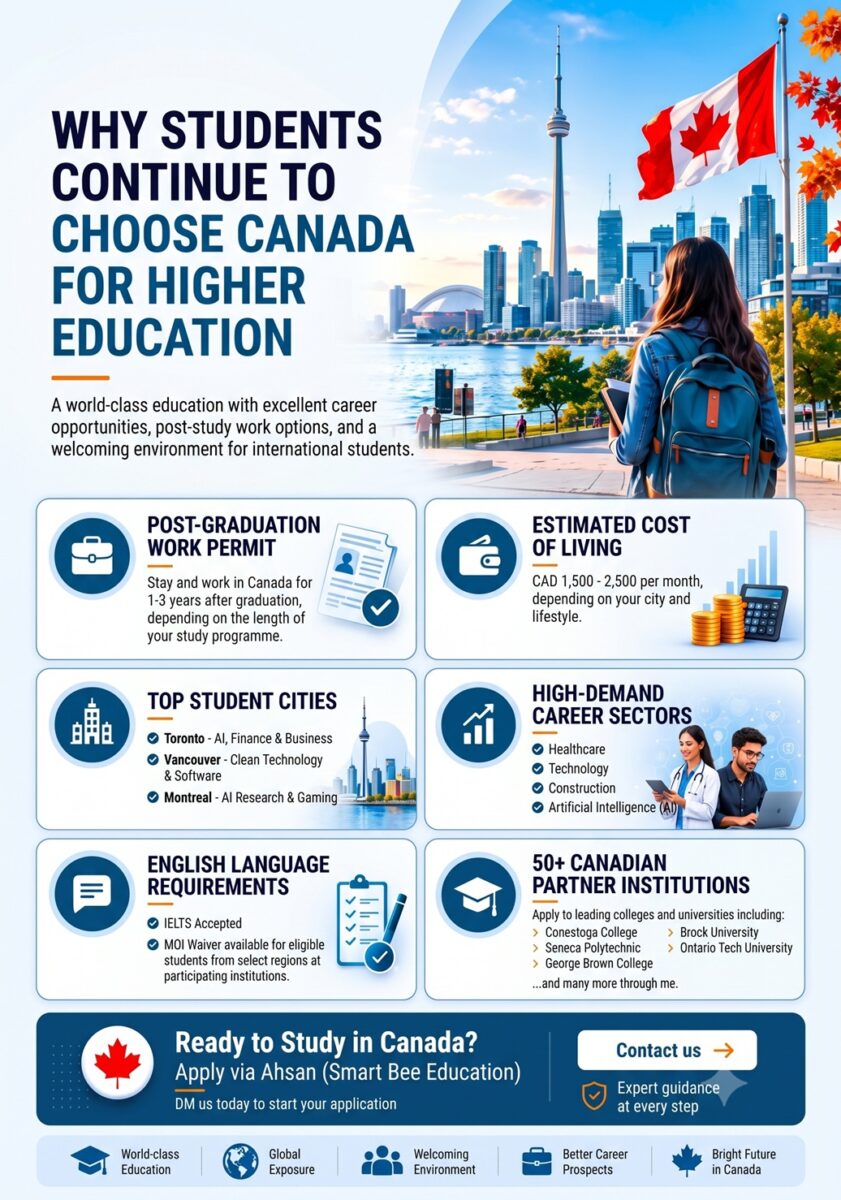
A Strategic Blueprint for Bangladeshi Applicants Targeting Canadian Education.
August 11, 2026THESE UNIVERSITIES HAVE ACCEPTED BANGLADESHI STUDENTS
August 24, 2026
Canadian Study Permit Report (2026)
A comprehensive overview of international student enrollment and visa approval trends from January to April.
Down roughly 40% compared to the same period in 2025.
Climbed by 10 percentage points from 26% a year earlier.
22% fewer approvals than the same period in 2025.
Overall Trends & Collapsed Demand
In the first four months of 2026, Immigration, Refugees and Citizenship Canada (IRCC) received about 38,000 new post-secondary study permit applications. This combination indicates that the pressure on new enrollments is coming from collapsed demand.
However, for the students who did apply, the odds improved, as Canada approved a higher share of a shrinking pool of applicants. Every month from January through April 2026 had a higher approval rate than the same month in 2025, reaching 42% in April compared to 29% a year earlier.
Permit Extensions & Sustainability Risks
Study permit extensions accounted for 77% of all post-secondary approvals in early 2026. Extension applications are typically approved at rates above 90%.
This imbalance points to a serious sustainability issue in Canadian international education. A shrinking intake of first-year students breaks the traditional enrollment cycle, leaving institutions scrambling to project budgets, distribute resources, and secure viable funding for the future.
Program Level Breakdown
Study permit approvals at every program level improved year-over-year in early 2026:
- Postgraduate (University): Recorded the highest approval rate at 49% (up from 39%), capturing 30% of all approved permits.
- Undergraduate (University): The approval rate rose to 44% (from 32%), securing 25% of all approvals.
- College Programs: The approval rate climbed to 30% (from 24%). Despite a lower approval rate than universities, college students still held the largest share of approvals at 43%.
- Vocational Programs: Held the lowest approval rate at 13%, making up only 2% of total approvals.
Strategic Insights for Recruitment
As demand softens, it is crucial to use data to identify and support well-matched applicants. When assessing an application, IRCC weighs whether the applicant is a genuine student with a well-supported study plan.
- Applicants who demonstrate a coherent progression from their past studies to their chosen program start from a much stronger position.
- Canada continues to need skilled talent in priority areas, including artificial intelligence.
- Connecting a student’s interest with these national priority areas can significantly improve approval outcomes.